A few words—“a pelican riding a bicycle”—leave almost an entire world unstated. The rider must belong to the bicycle. Its feet must stay related to the pedals. Motion must have a direction and a reference frame. Time must advance the scene consistently. A model can draw each object recognizably and still fail to make them coexist.
That is the question behind this study: when a language model generates a physical scene, does its program reconstruct the relationships that make the scene possible? The bicycle is the first probe into a larger question about AI and physical-world understanding.
 Animation stopped
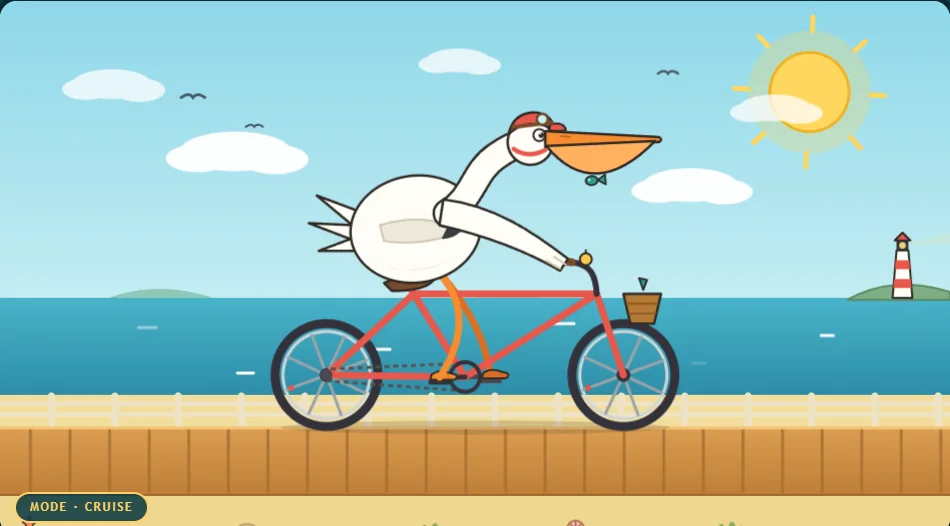
GLM-5.3 Flash MAX is my visual pick for the cover: the framed composition, rider movement, passing scenery and small interactions make it inviting to watch. That judgement concerns this saved scene. Its physical relationships still need their own examination, just as a less polished scene may contain a useful mechanism.
The pilot’s main finding is a gap between constructing plausible parts and preserving their relationships as a whole. Source inspection reveals failures of attachment, transform ownership and continuity. A controlled timing experiment adds a sharper result: one saved program changes its motion when only the update schedule changes, while another preserves its timing yet visibly fails its object attachments. The evidence points toward a problem of composition; it does not establish what the generator internally knows.
Why ask for an executable world?
An image lets us inspect an instant. An executable program also reveals how the next instant is produced: which objects share a coordinate system, which quantities depend on one another, and what changes when time advances. A wheel, a leg and a landscape can all animate while describing incompatible events.
The initial observation here was a weak sense of forward travel despite moving wheels and feet. That impression is an entry point, not a verdict. A following camera can keep a correctly moving bicycle fixed on screen. The research task is to turn an impression into a claim about the scene, then find evidence that could support or contradict it.
I use “executable world model” here for the generated representation of a scene, whose rules can be run and inspected. This gives external evidence about what the model can express in code. It does not give direct access to the language model’s internal representations.
What the model has to infer
The task came from the Codex Pulse benchmark. This is the complete prompt used in the documented requests:
pelican-bicycle-cli-v2-en
Do not load persistent memories or call subagents. Create an HTML file containing a 2D SVG animation of a pelican riding a bicycle. Output the complete, self-contained HTML source directly in your final response, without Markdown code fences or explanations. Do not call tools, read files, load skills, access the network, or write files. The caller will save your final response. All visible text in the animation, including titles, labels, and captions, must be in English. Set the HTML document's lang attribute to en.View the published benchmark prompt ↗
Verified against the saved requests. Some standalone variants have no matching request record.
The prompt specifies the subject and delivery format, but leaves the camera, scene geometry, contact relationships and timing model to the generator. It does not explicitly require a coastline or a moving chain. The omissions are useful: they reveal which relationships a model supplies when asked for an ordinary scene rather than a list of equations.
They also require a careful distinction. A stylized omission is different from a visible contradiction. An animation need not simulate every physical process to depict a plausible ride. Once it depicts a foot attached to a pedal or a road passing beneath a wheel, however, those choices create relationships that can be inspected.
The gallery contains 37 runnable programs in 31 model-and-setting groups. The exact prompt matches 14 saved harness constants and 38 standard request records; reused records are not independent trials. Some standalone variants lack a matching request record. The archive is an exploratory collection with those limits, not a controlled league table.
Local competence can coexist with a broken scene
GLM-5.3 Flash HIGH makes the problem unusually visible. It calculates two-segment legs that follow moving pedals. It also draws two long dark lines from the pedal region to the upper-left corner. The scene contains a useful local construction and an unmistakable structural failure at the same time.
Two crank arms start at the scene origin.
 Animation stopped
The lines are the crank arms. Their moving endpoints are updated, but their fixed endpoints are never assigned. SVG therefore places each start at (0, 0) instead of the bottom bracket. This fault exists in the saved source and remains in the running example; it was not introduced by the website’s embedding.
The consequence reaches beyond a cosmetic defect. The program has pedal coordinates and a bottom-bracket position, yet fails to connect one drawn component to the object it belongs to. A correct local calculation has not become a correct whole-scene representation. MAX explicitly anchors its crank arms at the bottom bracket and avoids this particular defect.
This locates a failure in the delivered program. It does not by itself distinguish missing physical knowledge from faulty spatial planning or an implementation mistake. A useful evaluation should separate those possibilities rather than give every failure the same explanation.
Source evidence: why the two lines reach the scene origin
HIGH declares armNear and armFar as SVG lines without x1 or y1. Its update assigns only x2 and y2, using the moving pedal positions. The omitted start coordinates evaluate to zero. The intended bottom bracket is stored separately at (600, 492).
MAX's armN and armF explicitly declare their starts at (572, 508), its bottom-bracket position. This is a source-level comparison of two saved outputs, not a repaired version or a general conclusion about reasoning settings.
A world has to agree across objects and across time
The black lines expose object attachment. Other samples expose different parts of the same larger problem.
Contact and direction disagree
 Animation stopped
Fugu Max · HIGH. Follow the feet around the crank, then compare the road dashes with the passing posts.
Opposing strands, separate clocks
 Animation stopped
Qwen3.8 Max · recorded default. The chain strands travel in opposing directions. Compare their motion with the independently timed wheel and crank.
Scene consistency. Fugu Max gives the rider articulated legs and opposing pedals, but its road dashes travel against the direction of nearby posts. Qwen3.8 Max provides a useful positive comparison: its boardwalk moves left and its chain strands travel in opposing directions. Individual relationships can succeed while the whole scene still needs examination.
Transform ownership. In Mistral Small 4, a plausible wheel-rotation calculation is attached to the assembled bicycle group. The distinction is about what the transformation acts on. Having a suitable number does not ensure that the represented object behaves correctly.
Time consistency. The first standalone Gemini 3.8 Flash HIGH variant computes elapsed time but advances its principal cadence by a fixed amount per frame. Its speed therefore depends on how often the browser updates. Later saved HIGH variants use elapsed time for their main updates. These are differences between artifacts, not a controlled estimate of a model’s repair ability.
Incomplete dependency propagation. DeepSeek V4 Pro 0813 MAX uses sprocket geometry to derive wheel and ground speed but leaves the visible chain static. GLM-5.3 Flash HIGH shares a speed across several parts but resets a 10-unit chain pattern after 12 units. Dependencies can be present and still stop short of a consistent rendered result.
These observations should remain separate. Counting visible detail would miss their differences; one overall impression of “physical understanding” would erase them.
A controlled change that should not change the world
The timing observation suggests an experiment with a known expectation. Keep a saved program and its controls fixed. Supply the same two seconds of elapsed time through three different schedules: 30, 60 and 144 animation callbacks per second. Measure how far the rear wheel turns, including complete revolutions. A scene whose motion is governed by elapsed time should preserve that total across these schedules.
This experiment was run on four selected, unchanged portfolio copies. It controlled the timestamps supplied to JavaScript; it did not measure real device frame rates. The results are:
More frames. A different amount of motion.
First standalone Gemini 3.8 Flash HIGH · accumulated rear-wheel rotation
Animation callbacks per second → degrees turned in the same two seconds
| Saved program | 30 / s | 60 / s | 144 / s |
|---|---|---|---|
| Gemini 3.8 Flash · HIGH · first standalone | 30 / s154.7° | 60 / s309.4° | 144 / s742.5° |
| Gemini 3.8 Flash · HIGH · later variant | 30 / s900.0° | 60 / s900.0° | 144 / s900.0° |
| GLM-5.3 Flash · MAX | 30 / s600.0° | 60 / s600.0° | 144 / s600.0° |
| GLM-5.3 Flash · HIGH | 30 / s245.6° | 60 / s245.6° | 144 / s245.6° |
The first standalone Gemini 3.8 Flash HIGH output turns its wheel about 4.8 times farther at 144 callbacks per second than at 30, despite receiving the same elapsed duration. Its update computes a time difference but advances the principal cadence once per callback. The observation matches that source-level explanation. The later Gemini variant and both GLM variants preserve their respective totals at the reported precision.
There is an important positive result here: the defect is discriminable, not inevitable. The same procedure separates a callback-count clock from three time-based implementations. Yet GLM-5.3 Flash HIGH still has the long crank lines seen above. Passing a temporal test and failing a spatial relationship are compatible outcomes in one artifact.
That coexistence changes the interpretation of the archive. It does not support a single ordering from “has physics” to “has no physics.” It supports examining which relationships are represented, whether they hold together, and where a local construction ceases to control the rendered world.
Experimental protocol, precision and limits
Each run loads a fresh copy at a 1000 × 700 viewport with default controls and reduced motion disabled. Before the document runs, a virtual clock replaces performance.now, requestAnimationFrame and cancellation. An initial callback at 1000 ms establishes the common baseline; subsequent callbacks end at 3000 ms, with 60, 120 or 288 steps. Rotation accumulated during initialization is subtracted.
The observable is the angle in the rear-wheel SVG transform, read after every callback and unwrapped across complete revolutions. Total rotation is reported to one decimal place. Source predictions agree within 0.11 degrees, allowing for the programs' own decimal rounding. Fresh source SHA-256 hashes were checked against the served documents; the research log retains hashes and per-frame readings.
The first Gemini program advances by 0.045 radians per callback. The later variant advances its wheel by 0.45 degrees per millisecond. GLM MAX uses a 1.2-second wheel period; GLM HIGH uses angular speed 150/70 radians per second. The 30–144 schedules stay below the later Gemini and GLM HIGH time-step caps. Pauses, long gaps, speed changes, CSS animations, timers and incidental random events are outside this measurement.
The four programs were selected to test a suspected timing fault against elapsed-time implementations, not sampled to estimate model reliability. This is one deterministic run per program and schedule, not independent model generation. A later saved variant is not evidence of a controlled repair trial. Equal rotation across schedules also does not establish correct wheel-to-ground physics.
Use a physical relation to test a claim
A formula is useful here when it discriminates between two explanations of what we see. If a wheel rolls without slip, its rotation and the ground’s relative motion must agree. Two independent animation loops can look synchronized for a while without preserving that relationship.
The wheel and the road must agree.
A simple no-slip relationship: ground speed v = angular speed ω × radius R.
Compatible speeds: one revolution corresponds to one circumference of travel.
The schematic isolates that one claim. It does not represent the full research agenda or a measurement of any model. Object identity, contact, occlusion, temporal continuity and the response to a changed situation remain distinct questions.
A worked rate check, and what it can establish
In one additional GPT-6 Sol output, the nominal wheel radius is 110 units and the rotation period is 2.5 seconds. The repeating ground segment travels 160 units in 0.58 seconds. The corresponding source-derived rates are 2π × 110 / 2.5 ≈ 276.46 and 160 / 0.58 ≈ 275.86 units per second. Their close agreement supports this particular nominal relation. It does not settle tire-contact geometry, transformed coordinates or every other part of the scene.
GLM-5.3 Flash HIGH provides a different kind of evidence. It sets wheel angular speed to V/R, crank speed to (V/R) × 13/16, and chain speed to crank speed × 16, updating them with elapsed time. Yet its chain offset wraps modulo 12 while stroke-dasharray="6 4" has a period of 10. That mismatch permits a two-unit phase jump. Shared state makes a dependency visible; its implementation can still violate continuity.
From a collection of faults to a research claim
The preliminary claim is about the difference between expressing a local relation and sustaining a system of relations. A program can contain a suitable equation and attach its effect to the wrong object; it can use elapsed time correctly while violating an attachment. More visual detail or one more correct formula would not, by itself, close that gap.
To test whether this is a recurring generation problem, the next study should compare matched prompts: an ordinary scene description, the same description with individual relationships named, and a request to maintain those relationships jointly under a specified change. Independent repeats and unfamiliar scenes would distinguish a one-off omission from a persistent difficulty. These generation experiments have not been run here.
The next program-level challenges would test other parts of the same argument:
- Change the coordinates, preserve the situation. Move the scene origin or scale the drawing. Attachments and relative motion should survive an equivalent representation. HIGH’s crank-origin error makes this an especially concrete target.
- Extend the timing intervention. The two-second default-speed experiment above is complete. Irregular updates, long pauses and control changes remain untested; time-step caps make their intended behavior a separate question.
- Intervene on a physical parameter. Where the saved source exposes one, change it without repairing the other equations. Predict which quantities should respond and which should remain fixed, then inspect the program’s actual dependencies.
- Change the task while retaining the principle. Extend the proposed study to other objects and interactions with explicit testable relationships. A broader claim about physical understanding needs evidence beyond a familiar bicycle scene.
Two experimental levels must stay distinct. Editing an existing program tests that program’s dependencies. Asking the model to generate or revise a scene tests the generator, including whether it can express those dependencies under different prompts. The latter needs independent repeats, recorded conditions and suitable comparisons; source editing alone cannot substitute for it.
The connection to FR-PIELM is constructive. Its zero-boundary basis shows how a relation can be guaranteed throughout a family of possible solutions. The animation cases show what happens when depicted relations are only partially enforced. Together they suggest a better unit of explanation: a relationship, the mechanism that maintains it, and the conditions under which it survives or fails. That is the bridge from these small examples to the larger question of AI and physical-world understanding.
Collection notes, provenance and retained faults
The collection contains 40 distinct generated source artifacts across 26 recorded model labels. The gallery runs 37 single-document programs, including one with retained formatting delimiters. A truncated output, an invalid reasoning-setting comparison and a malformed multi-document delivery are described in the gallery notes. An additional unavailable candidate supplied no animation.
Requested settings, output limits and recovery histories differ. An alleged GLM reasoning-off response reported substantial reasoning; the corrected comparison uses LOW, HIGH and the existing MAX. Identical reused files appear once. Distinct saved variants are not automatically independent repeats, and recorded model names are not independently verified backend identities.
Original animation faults remain visible, including HIGH's crank-origin error. One standalone Gemini HIGH variant can generate an invalid initial wave transform such as translate(--0.4, 0) when a prefixed minus sign meets an already negative offset. This startup defect is retained alongside its native controls.
The published programs remove identifying decorative text, private metadata and external font requests while preserving animation geometry and logic. No general ranking or claim about a model's internal understanding follows from this collection.